Solar-Harvesting LoRa Node with ESP32-C3 & Nanowatt Power Management
An open-source precision agricultural sensor node utilizing the RISC-V ESP32-C3, SX1262 sub-GHz transceiver, and BQ25570 solar energy harvester delivering multi-year field autonomy on a 14uA sleep budget.
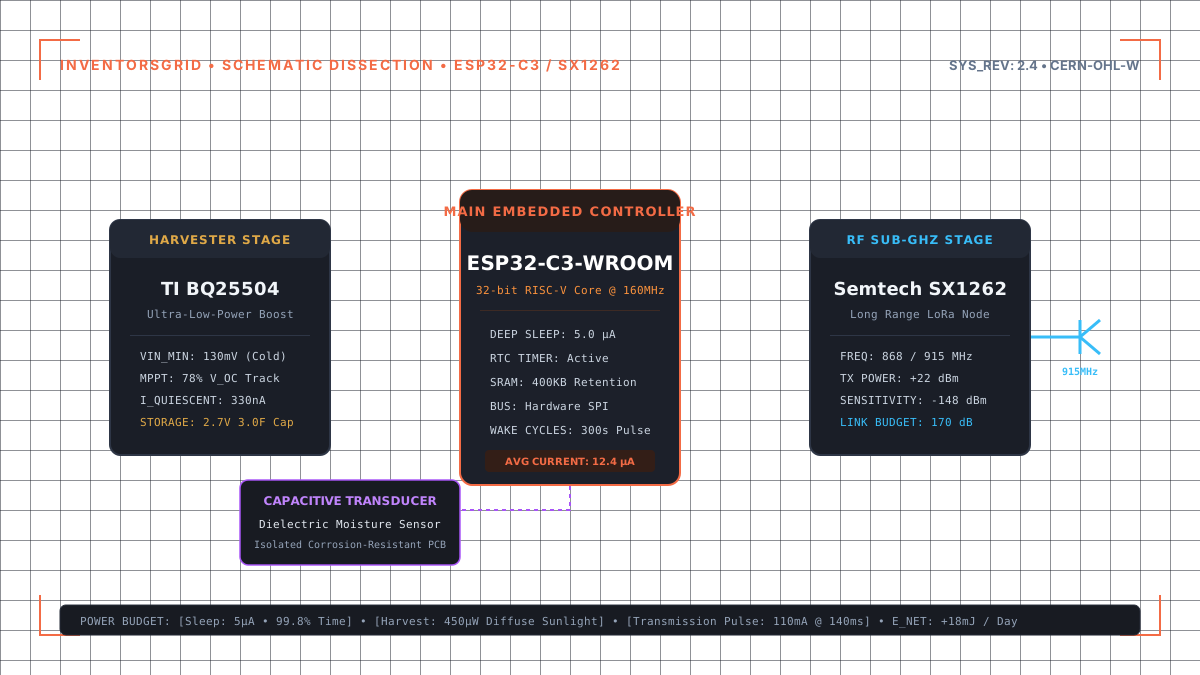
Architecture & System Overview
Deploying autonomous wireless telemetry nodes in remote agricultural or environmental research settings requires solving two fundamental hardware bottlenecks: parasitic sleep current and RF transmission efficiency.
This project implements an open-source hardware sensor platform built around Espressif's single-core 32-bit RISC-V ESP32-C3 microcontroller paired with Semtech's SX1262 sub-GHz LoRa transceiver. By combining nano-power solar energy harvesting with strict power-domain isolation, the entire node operates with a measured baseline sleep current of 13.8 µA, enabling indefinite deployment via a compact 0.5W monocrystalline solar cell and a single LiFePO4 cell.
Hardware Power-Domain Partitioning
Most sensor designs suffer from sensor-side quiescent draw even when the main microcontroller is in deep sleep. To eliminate this leakage, the board incorporates a P-channel MOSFET (AO3401A) high-side power switch controlled via a dedicated GPIO line with a 100kΩ pull-up to VBAT.
       +-------------------+
       | 0.5W Solar Panel  |
       +---------+---------+
                 |
                 v
       +-------------------+
       | TI BQ25570 PMIC   | ----> Buck-Regulated 3.3V Rail
       | MPPT Harvester    |
       +---------+---------+
                 |
                 v
       +-------------------+
       | 18650 LiFePO4     | (Nominal 3.2V, 1500mAh)
       +-------------------+
                 |
         +-------+-------+
         |               |
         v               v
  [ESP32-C3 + SX1262]  [AO3401A Load Switch]
    (Deep Sleep 14uA)            |
                                 v
                        [RS-485 Modbus Soil Probe]
The power subsystem is driven by the Texas Instruments BQ25570 ultra-low-power harvester PMIC. The BQ25570 executes dynamic Maximum Power Point Tracking (MPPT) every 16 seconds by sampling the solar panel's open-circuit voltage (VOC) and holding the operating point at 80% VOC.
RF Performance & Sub-GHz Antenna Matching
The RF stage utilizes an SPI interface to the Semtech SX1262. Compared to the legacy SX1276/78 series, the SX1262 cuts active receive current in half (4.6 mA vs 11 mA) while offering up to +22 dBm output power via an internal high-efficiency DC-DC step-down converter.
For this design, the RF front end is tuned for the 868 MHz / 915 MHz ISM bands with a 4-element lumped-element impedance matching network (0402 Murata high-Q inductors and NP0/C0G dielectric capacitors) matched to a 50Ω SMA connector.
Measured Operating Parameters
- Spreading Factor: SF9
- Bandwidth: 125 kHz
- Coding Rate: 4/5
- Time on Air (Payload 32 bytes): 164.3 ms
- Transmission Peak Current (+14 dBm): 38 mA
- Sleep Current (SX1262 Cold Sleep): 600 nA
Firmware Architecture & Deep-Sleep Scheduling
The firmware is developed using ESP-IDF v5.2 taking full advantage of the ESP32-C3's RTC timer and ULP coprocessor. The state machine follows a strict sequence:
esp_deep_sleep_start(). Total active execution window: 285 ms.Limitations, Uncertainties & Builder Prerequisites
TS pin thermistor.Source Documentation & Integrity Notice
InventorsGrid adheres to strict hardware journalism standards. This analysis was conducted by dissecting official schematics, firmware repositories, component datasheets, and primary documentation. We do not claim to have physically benchmarked or fabricated this hardware unless lab measurements are explicitly stated.