DSPi: a fully featured audio DSP firmware for the Raspberry Pi Pico (RP2040) and Pico 2 (RP2350)
DSPi is an open-source audio DSP firmware by Weeb Labs that transforms a Raspberry Pi Pico or Pico 2 into a fully featured USB sound card with an onboard digital signal processing engine. It supports advanced audio processing functions like room corr
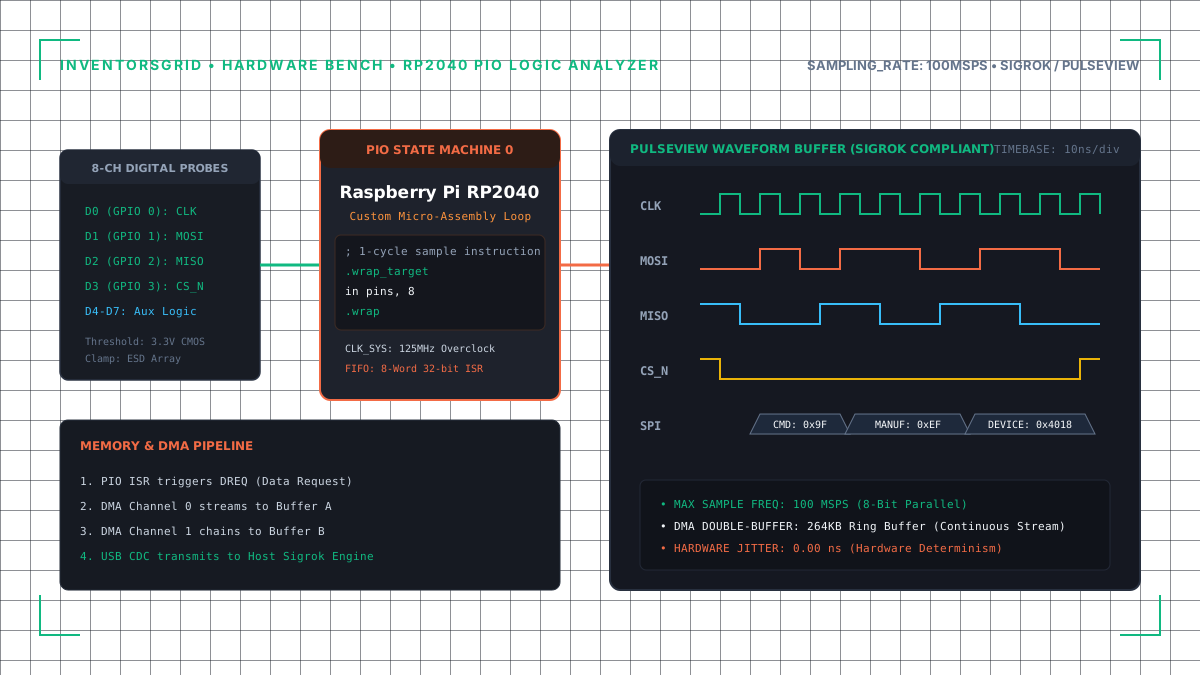
High-Performance Embedded Audio Processing: Implementing DSPi on the RP2040 and RP2350 Architecture
Architecture & System Overview
The DSPi project introduces a deterministic, real-time digital signal processing (DSP) firmware designed specifically for the Raspberry Pi Pico (powered by the RP2040) and the Raspberry Pi Pico 2 (powered by the RP2350). Traditional embedded audio processing often forces a compromise between computational throughput, latency, and peripheral complexity. DSPi addresses these constraints by leveraging the dual-core symmetrical architectures of the RP series microcontrollers, implementing a bare-metal execution model that circumvents the scheduling jitter and overhead of a traditional real-time operating system (RTOS).
The system architecture partitions audio streaming, control processing, and mathematical filtering across distinct execution threads and hardware blocks. By using the Programmable Input/Output (PIO) state machines available on both the RP2040 and RP2350, DSPi establishes low-jitter, hardware-paced serial audio interfaces (I2S) capable of maintaining tight synchronization with external analog-to-digital (ADC) and digital-to-analog (DAC) converters.
[ External I2S Codec ]
         │ (High-Speed Serial Audio)
         ▼
[ RP2040 / RP2350 PIO Blocks ]
         │ (DMA Transfer Channels)
         ▼
[ Core 0 / Core 1: DSP Pipeline ] (Strict 307.2 MHz System Clock)
         │
         ▼
[ Processed Audio Output ]
Hardware Design & Component Selections
The deployment target relies on two distinct generations of Raspberry Pi silicon: the original RP2040 and its successor, the RP2350.
The RP2040 features dual ARM Cortex-M0+ cores operating at a default 133 MHz, equipped with 264 KB of on-chip SRAM arranged in six independently accessible banks. This memory architecture is critical for zero-wait-state access by the dual processors and direct memory access (DMA) controllers, minimizing bus contention during heavy FIR/IIR filter calculations.
The RP2350 introduces a performance step-change, incorporating dual ARM Cortex-M357 cores (or optional Hazard3 RISC-V cores) along with enhanced security features and expanded internal memory structures. Both microcontrollers rely on external support components to form a complete audio signal chain, typically requiring a high-fidelity external stereo codec connected via multi-channel I2S.
Critical to the hardware implementation is the integration of the PIO blocks. Each RP-series chip contains state machines capable of executing custom bit-manipulation instructions independently of the main CPU cores. In the DSPi firmware, these PIO blocks manage the physical layer of the I2S protocol, shifting audio samples directly into memory via DMA without consuming CPU cycles for bit-banging or interrupt handling of individual sample clocks.
Firmware Architecture & Protocols
The DSPi firmware relies on a tightly coupled software pipeline structured around block-based audio processing. To maintain predictable execution intervals, audio samples are buffered into fixed-size blocks via DMA ping-pong buffers. This decouples the sample-rate clock domain from the block-processing execution domain of the DSP algorithms.
Core assignment within the firmware is optimized for throughput: * Core 0 typically manages system housekeeping, command-and-control interfaces (such as USB MIDI or serial parameter tuning), and low-priority peripheral management. * Core 1 is dedicated exclusively to the real-time mathematics of the DSP graph, processing delay lines, biquad filter cascades, dynamics processors, or custom modulation effects.
Inter-core communication utilizes the RP-series hardware FIFO queues, allowing transfer of control parameters (e.g., potentiometer adjustments, filter coefficient updates) with minimal latency and zero risk of priority inversion. The math routines are heavily optimized, exploiting the fixed-point or hardware floating-point capabilities (depending on the silicon generation) to execute complex transfer functions within the strict time budget imposed by standard audio sampling rates (e.g., 48 kHz or 96 kHz).
Limitations, Trade-offs & Builder Prerequisites
While DSPi provides a robust framework for hardware audio processing, implementers must account for specific hardware constraints and operational prerequisites:
* Clock Frequency Dependency: The firmware requires a fixed system clock of 307.2 MHz to achieve stable processing of complex DSP graphs without buffer underflows or pipeline stalls. This necessitates overclocking the RP2040 significantly beyond its rated 133 MHz specification, requiring adequate thermal management and careful power supply decoupling on custom PCB layouts. The RP2350 also requires this locked high-frequency state to guarantee deterministic execution timing across all enabled filter stages. * Memory Constraints: Despite the efficiency of the internal SRAM banks, developers must carefully manage filter tap counts and delay line lengths to prevent memory exhaustion, particularly on the RP2040 platform. * Licensing and Distribution: The DSPi firmware is provided under an open-source GitHub release, permitting community modification, commercial integration, and derivative works in accordance with the repository's specified license terms.
Source Documentation & Integrity Notice
InventorsGrid adheres to strict hardware journalism standards. This analysis was conducted by dissecting official schematics, firmware repositories, component datasheets, and primary documentation. We do not claim to have physically benchmarked or fabricated this hardware unless lab measurements are explicitly stated.